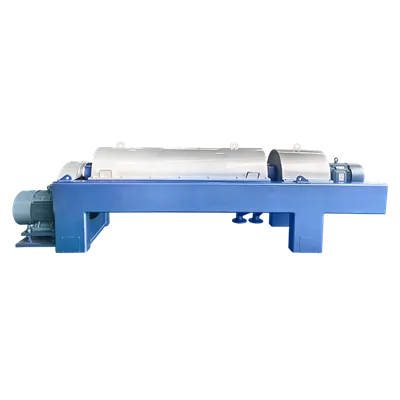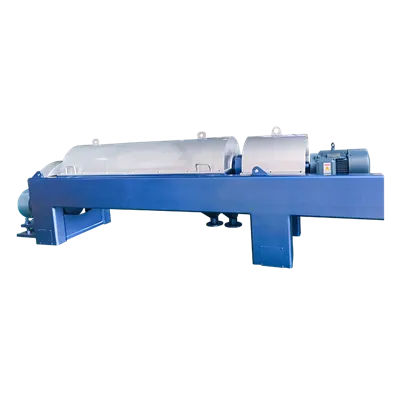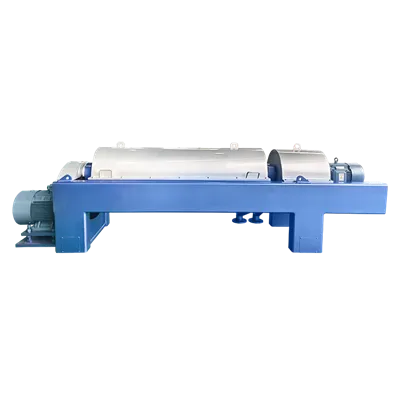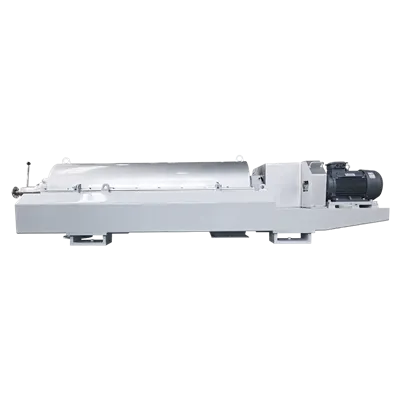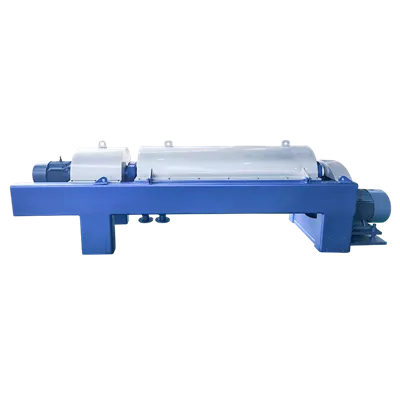
The three-phase horizontal screw centrifuge mainly consists of a drive unit, a rotating drum, and a screw conveyor, featuring a compact structure and small size. Its operation is based on the principle of sedimentation, where heavier solid particles settle out within a predetermined time.
This principle can also be applied to two immiscible liquids with a difference in specific gravity. When the material enters the high-speed rotating drum, it rotates synchronously with the drum. The relative motion between the screw and the drum is achieved by a differential gear. The screw blades continuously scrape off the solid particles deposited on the inner wall of the drum and push them out of the discharge port.
Due to differences in specific gravity, the centrifugal forces experienced are different. Heavier solid particles experience the greatest centrifugal force, followed by heavier liquids (such as water), and lighter liquids (such as oil) experience the least. This creates a concentric solid layer and two liquid layers from the outside in, according to the magnitude of the centrifugal force. The solids are pushed out by the screw conveyor, and the liquids are discharged from their respective outlets.
The heavier liquid (such as water) is typically discharged by a centrifugal pump, while the lighter liquid (such as oil) is discharged by gravity. The interface position between the light and heavy liquid layers (i.e., the oil-water interface) can be controlled by adjusting the liquid adjustment plate at the large end of the drum to improve the separation
effect.
Therefore, the application of a three-phase horizontal screw centrifuge can not only separate the solids from the three-phase sludge, but also separate the sludge from the oil, i.e., it can perform solid-liquid-liquid separation.