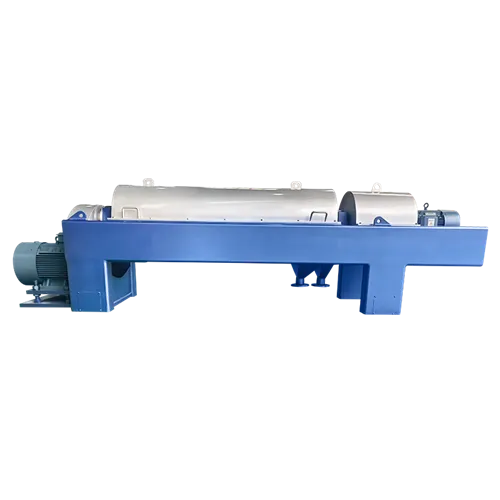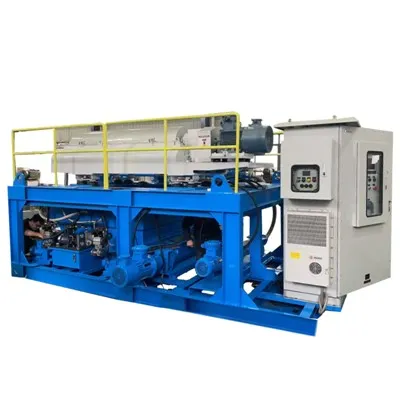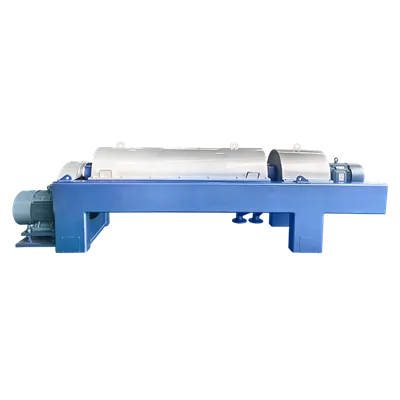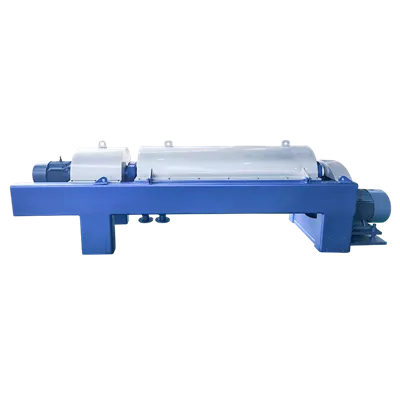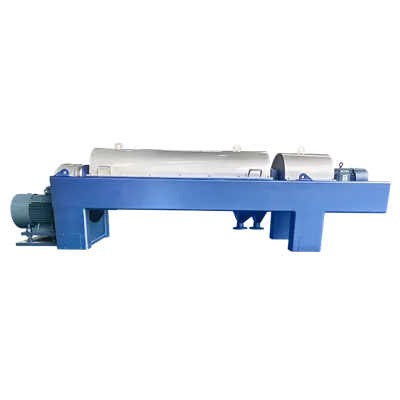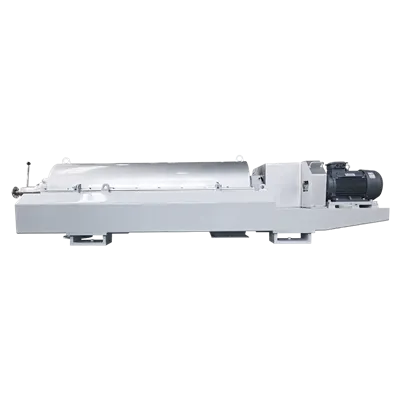
A three-phase horizontal screw centrifuge is a continuous solid-liquid separation device used in industries such as chemical, light industry, pharmaceutical, food, environmental protection, papermaking, and mining. It primarily achieves three-phase separation of solids from two liquids.
The equipment uses a main motor to drive a high-speed rotating drum, creating a centrifugal force field. Material is continuously introduced into the screw through the feed pipe and evenly distributed to the screw outlet. Utilizing the density difference of the material, solid-phase sedimentation and liquid-phase stratification are simultaneously achieved: the solid phase settles to the drum wall and is pushed out by the screw pusher towards the slag outlet of the conical drum, while the liquid phase flows out along the screw towards the overflow hole at the larger end of the drum, resulting in a separation effect where the solid phase exits at the smaller end and the liquid phase exits at the larger end. It can process mixtures with a solid content <10% and particle size <2mm.
The equipment consists of core components such as the drum, screw pusher, differential gear, and main and auxiliary motors. Drum diameters range from 360-550mm, and the processing capacity can reach 5-15 m³/h. It is equipped with hard alloy screw components and stainless steel contact materials. The screw conveyor using BD plate technology can reduce the solid phase water content, and with the help of a PLC automatic control system, it can achieve differential speed adjustment (0-30RPM) and optimization of operating parameters. Typical applications include oil refinery sludge treatment and biofuel production, where oil phase substances with a water content of ≤3% can be produced simultaneously in oil sludge separation.