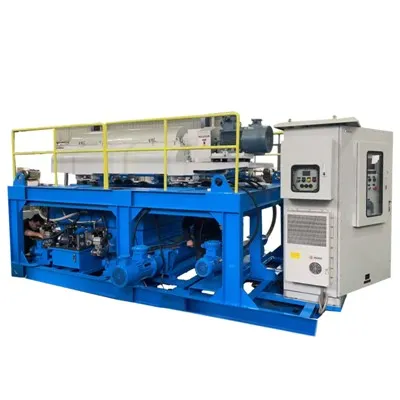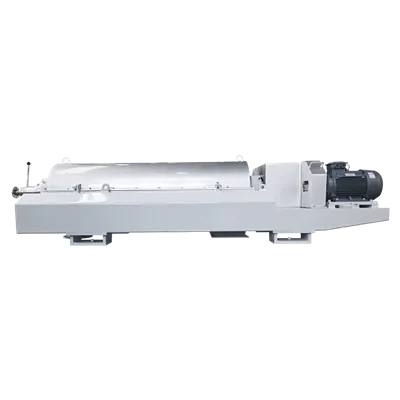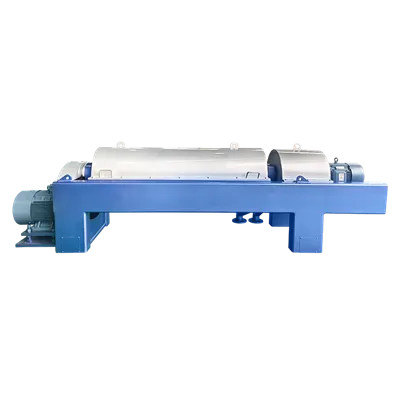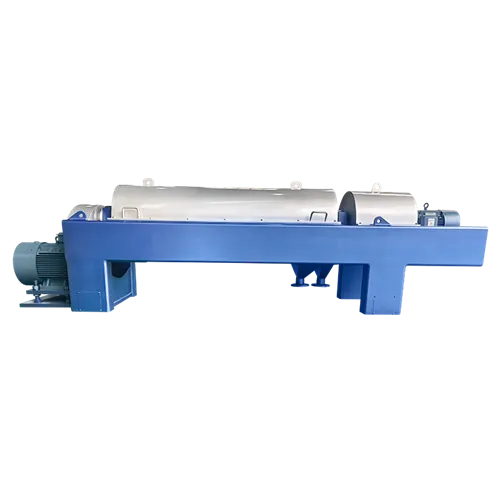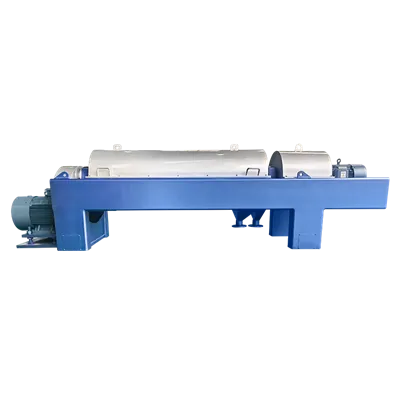
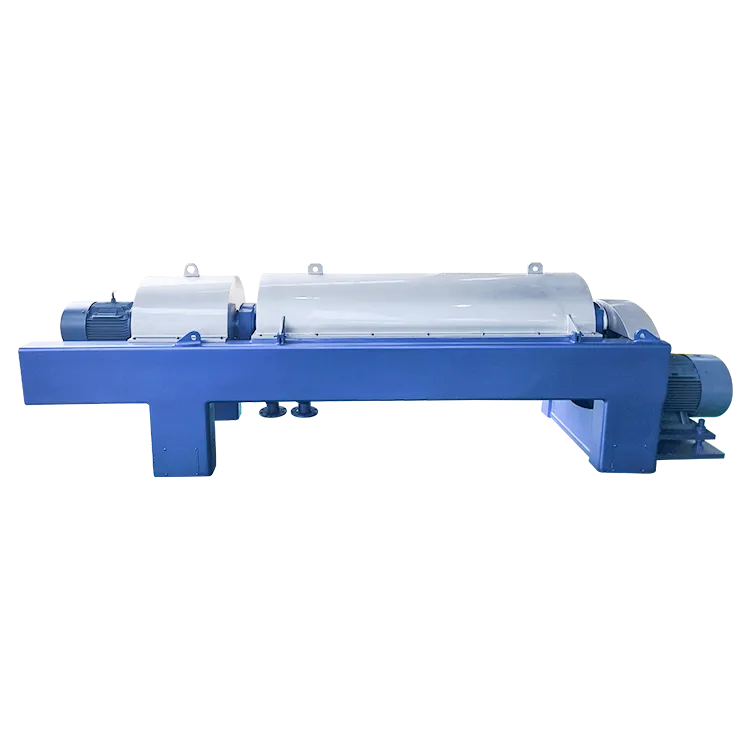
The Primary Sludge Thickening Decanter is a continuous-feed, solid-bowl centrifuge engineered to concentrate raw primary wastewater sludge from 0.5%–2% inlet consistency up to 5%–8% dry solids (DS). By applying a centrifugal force up to 3,000 × g, it separates suspended solids from wastewater streams without the large footprint required by gravity belt thickeners or dissolved air flotation (DAF) units. Built for municipal and industrial wastewater facilities, this unit integrates heavy-duty structural fabrication with precision-machined rotating assemblies to maintain stable operation under fluctuating organic loads.
Key Features
High G-Force Bowl Design: Optimizes solid-liquid phase separation for variable primary sludge characteristics.
Tungsten Carbide Hardfacing: Applied along scroll flight tips and solids discharge ports to resist abrasive grit wear (Visual evidence: vacuum-brazed tungsten carbide tile matrix forming a high-hardness protective barrier).
Dual-Motor Variable Frequency Drive (VFD): Independent control of bowl speed and differential speed ensures automatic torque adaptation to changing sludge consistencies.
Enclosed Odor-Control Housing: Vapor-tight stainless steel casing prevents fugitive sewer gases from escaping into the facility environment.
Heavy-Duty Gearbox: Planetary gear system designed for high-torque output and long service intervals under continuous 24/7 operation.
Technical Specifications
|
Parameter |
Specification Range |
|
Bowl Diameter (mm) |
350–900 |
|
L/D Ratio |
3.5:1–4.5:1 |
|
Max. Bowl Speed (RPM) |
2,500–4,500 (model-dependent) |
|
Hydraulic Capacity (m³/h) |
10–120 |
|
Solid Capture Rate (%) |
≥ 95% (with polymer addition) |
|
Main Drive Power (kW) |
15–160 |
|
Backdrive Power (kW) |
4–30 |
Separation Performance
Solid Recovery: Achieves ≥ 95% suspended solids capture efficiency, minimizing recycle load suspended solids returning to the headworks.
Thickened Sludge Consistency: Delivers stable discharge concentration between 5% and 8% DS, reducing downstream digester heating and volume requirements.
Polymer Optimization: Designed for specific energy inputs, requiring low polymer dosages (1.5–3.5 kg/t DS) to achieve target flocculation.
Suitable Materials & Applications
Materials of Construction
- Bowl and Scroll Body: Duplex Stainless Steel (EN 1.4462 / UNS S32205) or 316L stainless steel, centrifugally cast or forged to eliminate micro-porosity.
- Casing and Frame: Structural carbon steel with multi-layer corrosion-resistant epoxy coating, or full 304/316 stainless steel wetted parts.
- Wear Protection: Tungsten carbide tiles or sintered plates vacuum-brazed onto high-wear surfaces.
Typical Applications
- Municipal wastewater treatment plants (primary clarification sludge thickening).
- Industrial effluent treatment (pulp and paper primary fiber/sludge, food processing organic waste, tannery primary sludge).
Equipment Configuration
Rotating Assembly: Dynamically balanced bowl and scroll assembly according to ISO 1940 Grade G2.5 (Verified via in-house high-speed balancing test bunkers).
Bearings: SKF or FAG heavy-duty industrial bearings with automatic grease/oil lubrication systems.
Control Panel: PLC-based control system (Siemens S7-1200/1500 or Allen-Bradley) with HMI touch screen monitoring vibration, bearing temperature, torque, and motor load in real time.
Vibration Monitoring: Continuous accelerometer feedback linked to automated emergency shutdown interlocks.
Customization Options
Nitrogen Purging
Explosion-proof configuration (Exd II BT4) for installations handling combustible gas environments.
Skid-Mounted Units
Complete pre-piped assemblies including feed pumps, polymer dosing systems, control panels, and sludge macerators.
Wear-Resistant Bushings
Ceramic or stellite feed zone inserts for abrasive inorganic grit profiles.
Quality Control & Manufacturing Capabilities
In-House Machining: Large-scale CNC floor boring machines and high-precision vertical lathes ensure tight concentricity tolerances on bowl shells (< 0.05 mm).
Nondestructive Testing (NDT): Ultrasonic testing (UT) and dye penetrant testing (PT) performed on all structural welds and high-stress rotor forgings.
Dynamic Balancing: Every completed rotating bowl assembly undergoes high-speed balancing at operating speed on dedicated test bunkers.
Factory Acceptance Testing (FAT): No-load running test conducted for a minimum of 4 hours to verify vibration velocity (≤ 2.5 mm/s), bearing temperature rise, and electrical interlocks.
Installation & After-Sales Support
Installation Guidance: Detailed civil foundation loading diagrams, leveling procedures, and on-site commissioning supervision by factory service engineers.
Spare Parts Availability: Critical wear components (gaskets, bearings, wear tiles, seals) stocked for dispatch within 48 hours.
Technical Documentation: Comprehensive Operation & Maintenance (O&M) manuals, electrical schematics, PLC source code backup, and material mill test certificates (MTC 3.1) provided upon delivery.
FAQ
Request a Quote
To receive a formal technical proposal and commercial quotation tailored to your project requirements, please provide the following parameters:
Design Sludge Flow Rate: (m³/h or GPM)
Inlet Sludge Concentration: (% DS or mg/L)
Target Discharge Concentration: (% DS)
Project Location / Electrical Standard: (E.g., 480V/60Hz/3Ph)
Required Scope of Supply: (Standalone centrifuge vs. complete skid-mounted package)
Hot Tags: primary sludge thickening decanter, China primary sludge thickening decanter manufacturers, suppliers, factory, centrifugal sludge separator, centrifuge sludge thickening, Corrosion Resistant Sludge Thickening Decanter Centrifuge, Low Maintenance Heavy Duty Decanter Centrifuge, Remote Monitoring Solid Liquid Separation Decanter Centrifuge, Skid Mounted Sludge Dewatering Centrifuge